Seven Doors
Pop/rock album (Album is being mixed. Links to be updated upon release)
Spotify Amazon Music Apple Music YouTube
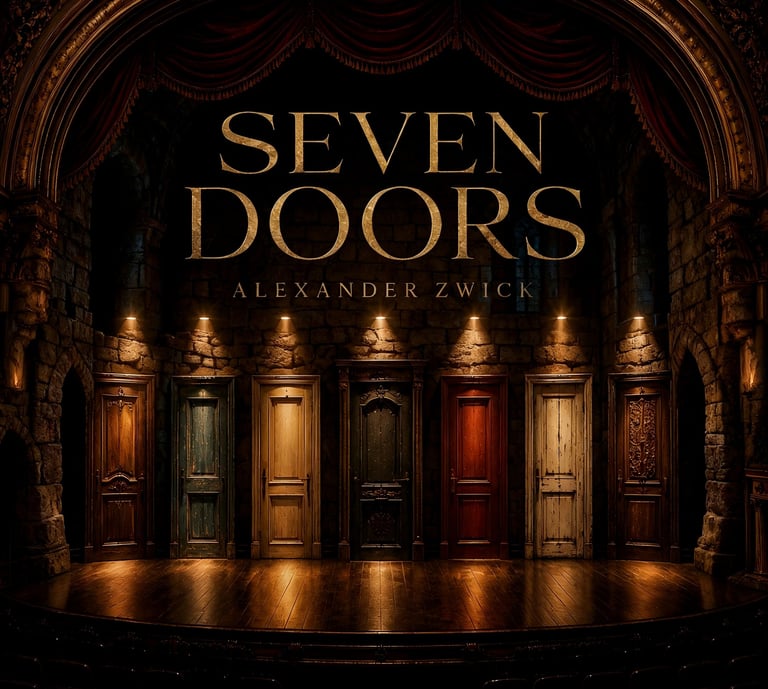

Seven Doors

Seven Doors is an album of seven songs, each based on a different musical mode.

Most people know the familiar “do-re-mi-fa-sol-la-ti-do” sound, even if they don’t think of it as a scale. That pattern is what musicians call the major scale, and it’s the basis for a lot of the music we hear.

Modes are related to that idea, but they use different patterns of notes. Some can sound bright and settled, while others may feel darker, stranger, older, more restless, or less expected. You don’t need to know the theory behind them to hear that they each have a different character.

For this album, I liked the idea of writing one song for each of the seven traditional modes and seeing where each one led me. The result is not meant to be a music theory lesson. It’s just a collection of songs that all began with the same challenge: start from a different musical pattern each time without sacrificing melody and without letting the the lyrical content be restricted by the musical feel.

The title Seven Doors came from that idea. Each song begins from a different musical starting point, and each one opens onto something different.

The Snow White song is based on the earliest known version of the story, "Snow White and the Seven Dwarfs" published by the Brothers Grimm in 1812 and finalized by them in 1854. It is told from the point of view of the queen, Snow White’s stepmother.

Snow White's father, the king, gets married again after his wife dies (in the 1854 version) to a beautiful, but also vain and wicked woman who practices witchcraft. Every morning, the new queen asks her magic mirror, "Magic mirror on the wall, who is the fairest one of all?" The mirror always tells the queen that she is the fairest, until one day when it tells her that Snow White is the fairest. The queen is enraged and eventually orders a huntsman to take Snow White into the forest and kill her, insisting that he bring Snow White's heart back as proof, which she will consume in order to become immortal.

The huntsman takes Snow White into the forest, but cannot kill her, instead agreeing to bring the queen the heart of an animal instead. After wandering through the forest, Snow White meets seven dwarves who agree to let her stay at their home to avoid her stepmother.

Ten years later, the queen, who believes she got rid of Snow White, is told by the magic mirror that not only is Snow White still the fairest in the land, but she is hiding with the dwarves. The queen decides to go after Snow White herself, disguising herself and giving Snow White a poisoned apple. The dwarves are unable to revive her and place her in a glass casket for her funeral. The next day, a prince stumbles upon Snow White in the glass coffin, learns of the story from the dwarves, and begins to take Snow White to be buried properly at her father's castle. Suddenly, while she is being transported, one of the prince's servants trips, dislodging the piece of poisoned apple from her throat, magically bringing her back to life. The Prince declares his love for her and she accepts his proposal of marriage.

The queen, thinking she has finally gotten rid of Snow White, asks again her magic mirror who is the fairest in the land. The mirror says that there is a bride of a prince, who is yet fairer than she. The queen goes to the wedding and discovers that the prince's bride is Snow White, and tries to kill her again. Enraged, the Prince orders the queen to wear a pair of red-hot iron slippers and dance in them until she drops dead. With the evil Queen finally defeated and dead, Snow White has taken her revenge, and her wedding to the prince peacefully continues.​

The "Beauty and the Beast" song is based on the 1740 fairy tale published by French novelist Gabrielle-Suzanne Barbot de Villeneuve. While there are similar stories from millennia earlier, this is the earliest version that is familiar to us. The song is told from the point of view of the Beast.

A widower merchant who lost all his wealth in a tempest at sea, finds shelter in a castle during yet another vicious storm. He finds an elaborate setup with food and drink, but the owner is nowhere to be seen. After spending the night, he sees a rose garden and remembers that the kindest, most selfless of his children, his daughter Beauty, asked for nothing more from him than a rose. A hideous "Beast" confronts him, and threatens his life for stealing his most precious possession after accepting his hospitality. When the merchant explains, the Beast agrees to let him give the rose to Beauty, but only if the merchant brings one of his daughters to take his place.

The merchant is upset but accepts as his other choice is to die. The Beast sends him off with jewels and fine clothing for his children. The merchant, arriving home, gives Beauty the rose, and explains what happened to the children. The older daughters blame Beauty, while the sons say they will go and fight, but Beauty insists on going to the Beast's castle herself.

The Beast treats her incredibly well, giving her everything she could ever ask for, and has long conversations with her, each night asking her to marry him, only to be turned down each time. After each refusal, Beauty dreams of a handsome prince with whom she starts to fall in love. A fairy appears, telling her not to be deceived by appearances, but Beauty doesn't understand, and assumes the Beast is holding this prince hostage somewhere in the castle. She searches the castle for him but turns up empty.

Beauty lives at the castle for months, with all the riches she could ask for, but eventually asks the Beast to allow her to go see her family again. He agrees, if she promises to return two months later. She agrees, and is given a magical ring, which transports her to her family's home. Her sisters, seeing her in her finery and well-fed, are unkind, even though she gives them gifts.

After two months, she imagines the Beast dying alone in the castle, and rushes to return, even though her brothers try to stop her. Back in the castle, she sees her premonition was right, finding the Beast near death in a cave on the castle grounds. She is overcome with sadness, realizing that she loves him. She fetches water from a nearby spring to resuscitate him. That night, she finally agrees to marry him. When she wakes up next to him, she sees that he has turned into the prince from her dreams. Soon, the fairy returns, along with the prince's mother, who is disappointed that Beauty is not of noble birth. The fairy chastises the mother and explains that in reality Beauty is the fairy's niece. Beauty's father is the Queen's brother from Fortunate Island and her mother is the fairy's sister.

That decided, the prince explains that his father died when he was young and his mother had to wage war to defend the kingdom. The queen left him in the care of an evil fairy, who tried to become romantically involved with him when he became an adult; when he refused, she turned him into a beast. However, by finding true love, the curse was broken. He and Beauty are married, and they live happily ever after....

The "Little Red Riding Hood" song is based on the 1697 story "Le Petit Chaperon Rouge" by Charles Perrault, which is the earliest known printed version of the fairy tale and may have had its origins in 17th-century French folklore. Perrault introduced the idea of the red hood. The song is told from the point of view of the wolf to Little Red Riding Hood.

An "attractive, well-bred young lady," lives in a village in the country. A wolf deceives her into finding her grandmother's house and eating the woman without being noticed by woodcutters in the nearby forest. Next, the wolf lays a trap for Red Riding Hood, disguising himself as her grandmother in bed, persuading Red Riding Hood to climb into the bed before being eaten by the wolf, where the story ends. The wolf emerges the victor of the encounter and there is no happy ending. The song, however, is less clear and has sexual overtones rather than just carnivorous ones.

The "Sleeping Beauty" song is taken from a version that may be less familiar to a modern audience, the Italian literary fairy tale, “Sun, Moon, and Talia” written by Giambattista Basile in his 1634 work, the Pentamerone. Charles Perrault retold this fairy tale in 1697 as "The Sleeping Beauty," as did the Brothers Grimm in 1812 as "Little Briar Rose." The song is told from the point of view of a third-person narrator.

When a great lord learns that his daughter, Talia, is foretold to be harmed by a splinter of flax, he commands that no flax ever be allowed into his home. Years later, Talia asks an old woman spinning flax on a spindle if she can stretch the flax herself, but as soon as she does so, a splinter of flax goes under her fingernail, and she falls to the ground, apparently dead. Her father can't bear the idea of burying his child, so he puts her body in one of his country estates.

Some time later, a king who is hunting in the woods, follows his falcon into the house. He finds Talia and tries to wake her, but can't. "Crying aloud, he beheld her charms and felt his blood course hotly through his veins. He lifted her in his arms, and carried her to a bed, where he gathered the first fruits of love." He leaves back to his own city. Talia becomes pregnant, and still deep asleep, gives birth to twins (a boy and a girl). One day, the girl tries to breast feed, but cannot find her mother's breast. She sucks her mother's finger instead and draws the flax splinter out. Talia suddenly wakes up and names her children Sun and Moon.

The king returns, sees Talia awake, and tells her that he is her children's father. They fall in love. However, it turns out that the king is already married. One night at his home, he calls out the names of Talia, Sun, and Moon in his sleep. His wife, the queen, hears this and discovers the truth. She has Talia's children brought to court and orders the cook to kill the children and serve them to the king. The cook, however, hides them, cooking two lambs instead. The queen taunts the king while he eats, unaware of what the cook did.

Next, the queen brings Talia to court. She orders that a huge fire be lit in the courtyard and that Talia be thrown in. The king discovers what is going on, and the queen tells him he has eaten his own children. The king commands that his wife and the cook be thrown into the fire instead. But the cook explains how he saved the children, and he is spared. Talia and the king marry.

The "Jack and the Bean Stalk" song is based primarily on Benjamin Tabart’s “The History of Jack and the Bean-Stalk," published in 1807. The song is told from Jack’s point of view.

Jack, a poor country boy, trades the family cow for a handful of magic beans, which grow into a towering beanstalk reaching up into the clouds. When he climbs the beanstalk he arrives in a castle where a woman feeds him, but he is soon sensed by her husband, an unfriendly giant, who cries, "Fee-fi-fo-fum!" Outwitting the giant, Jack flees, but returns while the giant is sleeping to retrieve many goods once stolen from his family, including a bag of gold, an enchanted goose that lays golden eggs and a magic golden harp that plays and sings by itself. However, the harp begins singing, which wakes the giant up. Jack escapes down the beanstalk with the giant in pursuit. Jack then chops down the beanstalk. The giant, who is pursuing him, falls to his death, and Jack and his family prosper.

The "Hansel and Gretel" song is based on the fairy tale collected by the German Brothers Grimm and published in 1812 in Grimm's Fairy Tales. The song is told from the point of view of a third-person narrator.

During a famine, a poor woodcutter's second wife tells him to take his children, Hansel and Gretel, out to the woods to survive on their own so that she and the woodcutter do not starve. The father protests, but his wife tells him maybe a stranger will take the children in and care for them, which she and the woodcutter just cannot do. Hansel and Gretel, having overheard this conversation, get white pebbles to help them when the time comes.

The next day, the family walks deep into the woods and Hansel lays a trail of white pebbles. When the woodcutter and his wife disappear, the children follow the pebbles back home, infuriatng the stepmother. She sends them out with the father again, even further, and this time makes sure they can't get any pebbles ahead of time.

The next morning, Hansel takes a piece of bread and leaves a bread crumb trail for them to follow. However, they realize that birds have eaten all the crumbs and they are lost. Several days pass, and they come upon a cottage made out of gingerbread, cookies, cakes, and candy. Hungry and tired, the children begin to eat pieces of the house when an old woman comes out and entices the kids to come in with the promise of soft beds and delicious food. They have no idea that this woman is actually a witch who built the gingerbread house to bring in children to cook and eat them.

The next morning, the witch locks Hansel in an iron cage and makes Gretel her slave. The witch keeps feeding Hansel to fatten him up, giving Gretel nothing but crab shells. Eventually, she prepares the oven for Hansel, but decides she is hungry enough to eat Gretel, too. She gets Gretel to the open oven and tries to trick her into leaning over in front of it to see if the fire is hot enough. Gretel, knowing what the witch has planned, pretends she does not understand. Infuriated, the witch demonstrates, and Gretel instantly shoves her into the hot oven, slams and bolts the door shut, and leaves "the ungodly witch to be burned in ashes." Gretel lets Hansel out of the cage and they discover a vase full of treasures, including precious stones. They take the treasures, and head for home. A swan takes them across an expanse of water, and at home they find only their father. His wife died from an unknown cause. Their father had assumed they had died, too, and is thrilled to see them happy and healthy.

The song involving a frog and a princess is based on "The Frog Prince," a German fairy tale published in 1812 by the Brothers Grimm. It is told from the point of view of the frog to the princess.

One day, a beautiful young princess was playing with a golden ball next to a fountain outside of the castle. After throwing it up and catching it many times, she missed it, and it rolled and fell into a deep well. She began to cry, at which point a frog appeared, and agreed to help her in exchange for her loving him, him being her companion, sitting by her at the table, eating off her plate, and sleeping in her bed. She agreed, but knew how silly this was and that she would never have to follow through. When he brought the ball out, she was delighted, and ran home, forgetting about the frog, who could not keep up with her.

The next day, she was eating at the table with her father the King and all the courtiers, when she heard the splish splash of the frog coming up the marble staircase. She opened the door and slammed it closed in fright. The king asked what was going on and insisted she explain. He said she must do what she promised and let him in. So she did. The frog insisted on being on the table and eating from her plate, and then sleeping in her bed. She was disgusted and cried, but the King insisted that she do as she agreed. In her bedroom, she threw the frog against the wall as hard as possible to make him be quiet. But when he fell down he was no longer a frog but a handsome prince. By her father's will, he was now her dear companion and husband. Then he told her how he had been bewitched by a wicked witch, and how no one could have delivered him from the well but herself, and that tomorrow they would go together into his kingdom. Then they went to sleep, and next morning when the sun awoke them, a carriage came with the prince's servant Faithful Henry. Faithful Henry had been so unhappy when his master was changed into a frog, that he had caused three iron bands to be laid round his heart, lest it should burst with grief and sadness. As the prince and the princess headed off for the prince's kingdom, there was a cracking sound. Faithful Henry explained that the bands around his heart were breaking because his master was set free and was happy.

The song based on the “Ugly Duckling” comes from the version by Danish author Hans Christian Andersen, first published in 1843. It is told from the point of view of the duckling.

After a mother duck's eggs hatch, the other animals perceive one of the ducklings as an ugly little creature and they abuse him verbally and physically. He wanders from the barnyard and lives with wild ducks and geese until hunters slaughter the flocks. Soon, he finds a home with an old woman, but her cat and hen taunt him to no end, and once again he sets off alone.

The duckling sees a flock of migrating wild swans. He is excited but cannot join them, for he is too young, ugly, and unable to fly. When winter arrives, a farmer finds and carries him to the farmer's home, but he is frightened by the farmer's noisy children and leaves the house. The duckling spends a miserable winter alone outside, mostly hiding in a cave on a nearly frozen lake.

The duckling, now having fully grown and matured, cannot take this life anymore. He decides to throw himself at a flock of swans, feeling that it is better to be killed by such beautiful birds than to live a life of ugliness. To his surprise, the swans welcome and accept him, and upon looking at his reflection in the water, he realizes that he had been not a duckling but a swan all this time. The flock takes to the air, and he spreads his wings to take flight with the rest of his new family.

The song based on “The Three Little Pigs” comes from "The Fox and the Pixies" published in 1853 in Devon, England and “The Story of the Three Little Pigs” by James Halliwell-Phillipps in 1886 and Joseph Jacobs in 1890.

The pixies (or pigs) are sent out by their mother to "seek out their fortune." The first little pig builds a house of straw, but a wolf blows it down and eats him. The second little pig builds a house of sticks, which the wolf also blows down (although with more effort) and eats him, too. Each time, the wolf says,

"Little pig, little pig, let me come in."
"No, not by the hairs on my chinny chin chin."
"Then I'll huff, and I'll puff, and I'll blow your house in."

The third little pig builds a house of bricks, which the wolf is unable to blow down. He then attempts to trick the pig out of the house by asking to meet him at several different places at specific times, but the pig outwits him each time since the pig gets to those places earlier than the wolf. Finally, the infuriated wolf decides to come down the chimney. The pig lights a pot of water on the fireplace. The wolf falls in and is boiled to death, avenging the death of the final pig's brothers. After cooking the wolf, the pig proceeds to eat the meat for dinner.

The song based on what would eventually become "Goldilocks" comes from the "The Story of the Three Bears," by Robert Southey, first published in 1837. The story is told from the point of view of the woman who enters the bears’ home.

Three "bachelor" bears, "a little, small, wee bear, a middle-sized bear, and a great, huge bear," live together in a house in the woods. Southey describes them as very good-natured, trusting, harmless, tidy, and hospitable. Each of them has his own porridge bowl, chair, and bed. One day they make porridge for breakfast, but it is too hot to eat, so they leave to take a walk in the woods while it cools. An old, bad-mannered, dirty vagrant woman, sent away from her family because she is a disgrace to them, approaches the bears' house. She looks through a window, peeps through the keyhole, and lifts the latch. After making sure that no one is home, the old woman eats the Wee Bear's porridge, then sits into his chair and breaks it. She then finds the bears' beds and falls asleep in Wee Bear's bed. Soon, the bears return. Wee Bear finds his empty bowl, his broken chair, and the old woman sleeping in his bed and cries, "Somebody has been lying in my bed, and here she is!" The old woman wakes, is chased out of the house by the huge bear and is never seen again.

The Pinocchio song is based on the “The Adventures of Pinocchio” children's fantasy novel by Italian author Carlo Collodi, published in book form in 1883. It is told from the point of view of Pinocchio.

In Tuscany, Italy, Geppetto, a poor man who plans to make a living as a puppeteer, carves a block of wood into a boy and names him "Pinocchio." As soon as Pinocchio's feet are carved, he tries to kick Geppetto. Once the puppet has been finished and Geppetto teaches him to walk, Pinocchio runs out the door and off into town. He is caught by a Carabiniere, who assumes Pinocchio has been mistreated and puts Geppetto in prison.

Pinocchio then goes back to Geppetto's house, where a talking cricket explains to him about the dangers of being disobedient. Angry, Pinocchio throws a hammer at the cricket, accidentally killing it.

Pinocchio knocks on a neighbor's door for food who fears he is pulling a child's prank and instead dumps water on him. Cold and wet, Pinocchio comes home and lies down on a stove; when he wakes, his feet have burned off. Luckily, Geppetto is released from prison and makes Pinocchio a new pair of feet. In gratitude, he promises to attend school, and Geppetto sells his only coat to buy him a school book.

On his way to school the next morning, Pinocchio passes a marionette theater and sells his new school book to buy a ticket for the show. The during the performance, the puppets call out to him, angering the puppet master, who decides to use Pinocchio as firewood. Pinocchio pleads for his life and tells about Geppetto's poverty, and his released.

On his way home, Pinocchio meets a fox and a cat. They trick him into an elaborate ruse where they attempt to rob him, and then hang him, which he falls for even though the ghost of the talking cricket tells him to go home to his father. A fairy comes to rescue Pinocchio, along with three doctors, one of whom is the ghost of the talking critic, who says Pinocchio is fine but has been disobedient to his poor father. Pinocchio had stuffed coins in his mouth so they wouldn't be stolen from him, but tells the fairy they were taken, causing his nose to grow. The fairy explains that his lies make his nose grow, and calls in some woodpeckers to chisel it back down to size.

Heading out to meet his father, Pinocchio encounters the fox and the cat again, who convince Pinocchio to bury his coins, which they promptly dig up and take. Pinocchio reports the theft to the courthouse, who sentences Pinocchio to four months in prison for the crime of foolishness. But all criminals are released early when a celebration is declared after the town defeats its enemies in battle.

Pinocchio continues to get into more precarious situations which he must get out of, Geppetto is swallowed by a fish, and the fairy takes him in, acting as his mother. She says that if Pinocchio does well in school and is good for one year, he will become a real boy.

Pinocchio does well in school, making the other boys jealous, and leads to him getting into mischief again. The fairy tells him he will be a real boy the next day and should invite all his friends to a party, but instead he gets distracted and goes to a place called Toyland with a boy named Candlewick. After having an amazing time there for five months, Pinocchio and Candlewick awake with donkeys' ears, and soon turn completely into donkeys, a results of doing nothing but playing and never studying. Pinocchio is sold to a circus, but falls and sprains his leg. The ringmaster sells him to a drum-maker, who throws him into the sea to drown him. But instead of drowning, Pinocchio turns back into a living marionette. The fish had eaten all the donkey skin off him. Pinocchio dives back into the water and swims out to sea, where he is swallowed by the same fish that swallowed Geppetto. Pinocchio and Geppetto escape with the help of a tuna and look for a new place to live.

Pinocchio and Geppetto encounter the Fox and the Cat, now poor and miserable. They continue on to a small house, which is home to the talking cricket, who says they can stay. Pinocchio gets a job doing work for a farmer and recognizes the farmer's dying donkey as his friend Candlewick.

After many month working for the farmer and supporting the ailing Geppetto, Pinocchio goes to town with the forty pennies he has saved to buy himself a new suit. He discovers that the fairy is sick and needs money. Pinocchio instantly gives the a snail he met in his adventures all the money he has for her. That night, the fairy visits him in his dreams. When he wakes up, he is a real boy. His former puppet body lies lifeless on a chair. The fairy has also left him a new suit, boots, and a bag which contains 40 gold coins instead of pennies. Geppetto also is healthy again.

One song is based on “The Little Mermaid,” a literary fairy tale written by the Danish author Hans Christian Andersen, first published in 1837. The song is told from the point of view of the mermaid.

The Little Mermaid lives in an underwater kingdom with her widowed father, grandmother, and five older sisters. When a mermaid turns fifteen, she may swim to the surface to see the world above for the first time, and then repeat this once every year. When the Little Mermaid turns fifteen, she goes to the surface and falls in love with a handsome prince whom she sees having a birthday celebration on a ship. A violent storm hits, sinking the ship, and she saves him from drowning. But after safely delivering him to the shore unconscious to be found by a young woman from a temple, the prince never sees the Little Mermaid or realizes she saved his life.

Saddened, the Little Mermaid learns from her grandmother that humans only live a short time, unlike a mermaid's 300 years, but that their souls live on eternally in heaven while mermaids turn to sea foam at death and cease to exist. The Little Mermaid, wishing to be with the prince, visits the Sea Witch who gives her a potion that gives her legs in exchange for her beautiful voice. The witch warns her that once she becomes a human, she can never come back to the sea, and that drinking the potion will make her feel as if a sword is being passed through her body. When she gets her human legs, she will be able to dance like no human ever has, but she will constantly feel like she is walking on sharp knives. She will also only get a soul if she wins the love of the prince and marries him, for then a part of his soul will flow into her. If not, at dawn on the first day after he marries someone else, the Little Mermaid will die with a broken heart and dissolve into sea foam upon the waves.

The Little Mermaid agrees, drinks the potion and feels the tremendous pain. She is discovered naked on the shore by the prince, who is struck by her beauty, even though she cannot speak. She dances for him, even though it is excruciatingly painful. Soon, she becomes his favorite companion, but he does not fall in love with her. When his parents push him to marry the neighboring princess who was the woman from the temple who he thinks saved him, he declares his love for the princess and a royal wedding is announced.

As the prince and princess celebrate their new marriage aboard a wedding ship, the Little Mermaid's heart breaks. She thinks of all that she has sacrificed and of all the pain she has gone through for the prince. She thinks of the death that awaits her, but soon her sisters rise out of the water and bring her a dagger that the Sea Witch has given them in exchange for their long, beautiful hair. If the Little Mermaid kills the prince and lets his blood drip on her feet, she will become a mermaid once more, all her suffering will end, and she will live out her full life in the ocean with her family. However, the Little Mermaid cannot bring herself to kill the sleeping prince, and she throws the dagger and herself off the ship into the water. Her body dissolves into foam, but instead of ceasing to exist, she feels the warm sun and discovers that she has turned into a luminous and ethereal earthbound spirit. As the Little Mermaid ascends into the atmosphere, she is greeted by other daughters, who tell her she has become like them because she strove with all her heart to obtain an immortal soul. Because of her selflessness, she is given the chance to earn her own soul by doing good deeds for mankind for 300 years, and will one day rise up into Heaven.

One of the songs is based on "Rapunzel," a German fairy tale first published by the Brothers Grimm in 1812, and developed from the French literary fairy tale of Persinette by Charlotte-Rose de Caumont de La Force (1698). It is told from the point of view of a prince.

A pregnant woman experiences cravings for the rapunzel (a salad green) growing in the high-walled garden next door that belongs to a sorceress and will eat nothing else. The husband, seeing her waste away and fearing for her life, breaks into the garden to get some for her. The sorceress catches him and accuses him of theft. He begs for mercy and she agrees to be lenient, allowing him to take all the rapunzel he wants on condition that he give the baby to her when it's born. Desperate, he agrees.

A baby girl is born and the sorceress takes her to raise as her own, naming her "Rapunzel" after the plant her mother craved. She grows up to be a beautiful child with long golden hair. When she turns twelve, the sorceress locks her up in a tower without a door or stairs, with only one room and one window, in the middle of the woods.

When the sorceress visits, she calls out, "Rapunzel! Rapunzel! Let down your hair, that I may climb thy golden stair."

One day, a prince rides through the forest and hears Rapunzel singing from the tower. Entranced, he returns often, listening to her beautiful singing, and one day sees how the sorceress gains access. When the sorceress leaves, he bids Rapunzel let her hair down. When she does so, he climbs up and they fall in love. He eventually asks her to marry him, and she agrees.

Together they plan her escape. He will visit each night and bring her a piece of silk for her to weave into a ladder. One of these nights, they sleep together and she becomes pregnant. The sorceress soon realizes this, cuts off Rapunzel's hair, and sends her out into the woods to fend for herself.

When the prince calls that night, the sorceress lets the severed hair down to haul him up. To his horror, he finds himself meeting her instead of Rapunzel, who is nowhere to be found. After she tells him in a rage that he will never see Rapunzel again, he leaps or falls from the tower and lands in a thorn bush. Although it breaks his fall and saves his life, it scratches his eyes and blinds him.

He spends years wandering until he eventually hears Rapunzel singing in the woods, where she now lives with their twin boy and girl. When they fall into each other's arms, her tears immediately restore his sight. He goes with her and their twins to his kingdom where they live happily ever after.

One song is based on an earlier incarnation of the “Puss in Boots” story, “Costantino Fortunato” (ca. 1550-1553) by Fiovanni Francesco Straparola, which differs from the later and more widely known version by Charles Perrault from 1697. This song is told from the point of view of a son who inherits a cat.

A poor woman in Bohemia dies, leaving to her three sons all she has, a bread kneading trough, a pastry board, and for her handsome son Costantino, a cat. Costantino's brothers treated him cruelly, taunting him and not sharing food with him.

However, Costantino's cat was actually a fairy in disguise and assured Costantino that the cat would take care of him. The cat went to the king's palace and insisted on meeting with him. He explained that his master, Costantino, had sent a hare as a gift. The cat was treated to a fine meal and left with lots of food concealed for Costantino.

Costantino's brothers, seeing these spoils, asked to have some, but he refused to share, just as they had done to him, making them angry and jealous.

The cat continued bringing gifts to the king, always saying they were from Costantino, and always bringing food back for his master. One day, the cat instructed Costantino to jump into a nearby river. The cat yelled out that Costantino was drowning, which happened to be heard by the king who had his servants rescue him. The cat told the king that robbers had thrown him into the river after they took jewels from him that he had planned on giving to the king.

The king, amazed, decided to wed his daughter Elisetta to Costantino and gave them a great endowment of riches after the wedding. On the way to Costantino's house, the cat used his wiles to arrange for servants for Costantino, tricked men into pretending they were Costantino's servants and even arranged for a stately castle to appear to be Costantino's home.

Not long after this, the king of Bohemia died, and the people chose Costantino for their king, seeing that he had married Elisetta, the late king's daughter, to whom by right the succession to the kingdom belonged. And so it was that Costantino rose from poverty to be a powerful king, and lived long with Elisetta his wife, leaving children by her to be the heirs of his kingdom.

Answers

Magic Mirror (Snow White)

Breadcrumbs (Hansel and Gretel)

Like I Treated You (The Frog Prince)

Another Night (The Ugly Duckling)

Don't Look Too Closely (Little Red Riding Hood)

A Beast for You (Beauty and the Beast)

Fee-Fi-Fo-Fum (Jack and the Beanstalk)

Memphis (Cinderella)

Long Way Back Home (The Three Little Pigs)

Just Right (Goldilocks)

Like There’s No Tomorrow (Pinocchio)

Couldn’t Make You Fall (The Little Mermaid)

Climb Any Tower (Rapunzel)

Sun and Moon (Sleeping Beauty)

Believe In Me (Puss in Boots)

Alexander Zwick

aazwick@aol.com

© 2024. All rights reserved.